
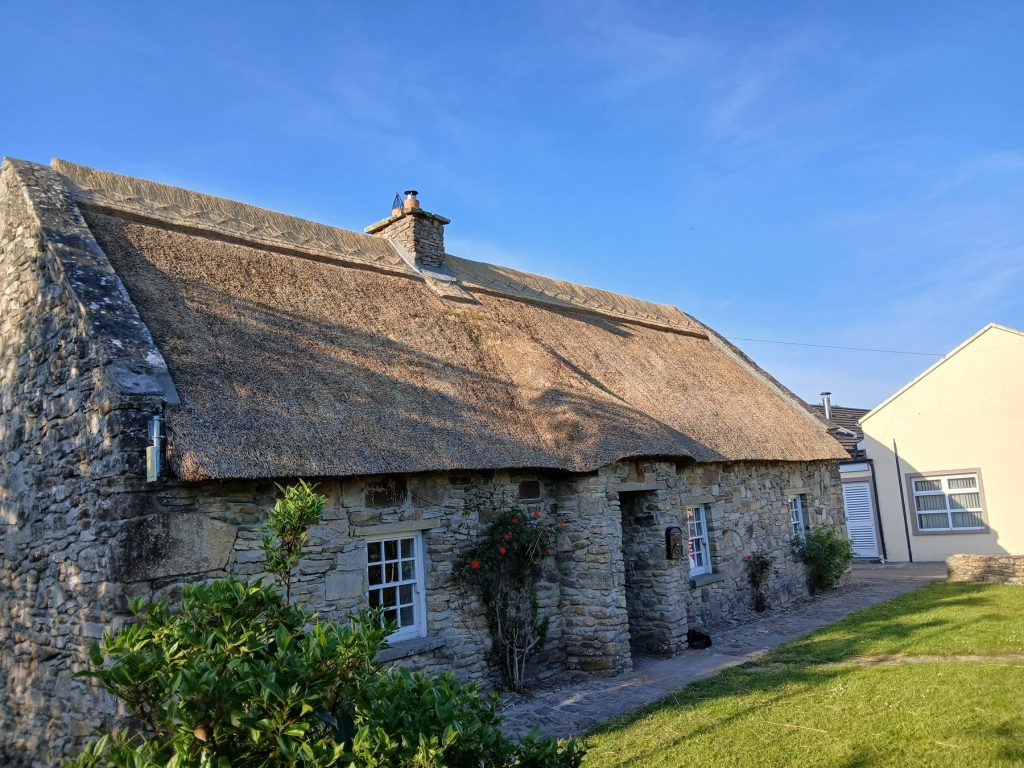
Ireland now has a stack of thatching grants, not a single cheque.
The two that matter most are the older housing Thatching Grant and the newer Historic Thatched Buildings stream. Beside those sit the mainstream Built Heritage Investment Scheme, the larger Historic Structures Fund, a farm-buildings scheme that likes thatch, and Donegal’s small-repair grant.Oireachtas
Figures below are as published in late September 2026. Circulars and county closing dates change; always confirm on gov.ie and with the county Architectural Conservation Officer before anyone climbs.
1. The Thatching Grant — the housing scheme
This is the older, quieter grant, aimed at people who live under the thatch.
House 10 years or older, structurally sound, already thatched (you cannot use it to put thatch on a building that never had it)
After the work it must be the normal place of residence.
Holiday homes are out
Standard ceiling €3,810, or two-thirds of approved cost, whichever is less
Specified islands: €5,714
Medical-card owners: €6,350, or 80% of approved cost (€8,252 on the islands)
Approved cost must exceed €952
A previous grant under this scheme, or the old Roinn na Gaeltachta scheme, usually blocks a new one for seven years
The quality rules in memorandum HA2T read like Thatching Ireland’s own working spec:
experienced tradesman;
suitable straw or reeds;
rotten thatch stripped;
holes packed;
a full renewal at least 350 mm (14 inches) on a firm base;
ridges, eaves and verges that keep water out;
flashing at the chimney;
protection against birds and vermin.Gov.ie
The process is inspection-led.
Apply early.
Wait for the inspector.
Do not start when the inspector has merely called — wait for the eligibility decision and the Certificate of Approval.
When the work is finished, owner and thatcher both sign. A final inspection follows.
Start before inspection and the grant is gone. That single rule catches more well-meaning owners than any other.
2. Historic Thatched Buildings — the conservation scheme
Since 2023 the Built Heritage Investment Scheme has carried a dedicated thatch stream. It exists because thatch is expensive, thatchers are scarce, and the buildings matter whether or not they sit on the Record of Protected Structures.
2025 dedicated stream: 61 projects, about €651,000
2026: almost €1.1 million to thatched buildings when the dedicated stream (~€600,000) and mainstream BHIS thatch awards were counted together
2027 window (open now): apply to the local authority by 30 October 2026;
awards early 2027;
money claimed in calendar 2027
Maximum €20,000, up to 80% of approved cost, 20% match from the owner
Councils are explicit: most awards are under the cap, and nobody is guaranteed a figure Gov.ie
Eligible structures are historic thatched buildings in domestic or commercial use.
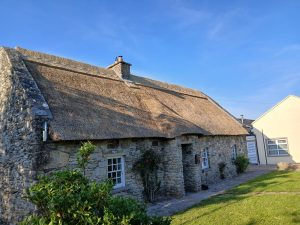
Donegal — one of the densest surviving concentrations — states the building need not be a Protected Structure.
Primary works are thatching plus the jobs that complete the roof: chimneys, flashings, necessary carpentry.
A method statement with an experienced thatcher is required.
Photos before and after are required. Works should be minimal-intervention and use appropriate materials.Gov.ie
You may apply to HTB and to mainstream BHIS, but only one grant is paid per structure. Pick the stream that fits the job.
3. The wider built-heritage familyBuilt Heritage Investment Scheme (mainstream).
€2,500–€50,000, up to 80% of cost, for Protected Structures, buildings in Architectural Conservation Areas, and vernacular buildings that lack formal protection.
Same 30 October 2026 close for 2027 work.Gov.ie
Historic Structures Fund.
The larger sibling, typically €50,000–€200,000, for substantial conservation.
Close 27 November 2026 for 2027.
A full re-thatch plus structural repair on a significant building sometimes belongs here rather than under the €20,000 HTB cap.
Traditional Farm Buildings Grant Scheme.
Heritage Council with Department of Agriculture money.
In 2026 the pot was €750,000, grants €4,000–€30,000 at up to 75%.
The building must sit on a holding already in the relevant farm scheme, and have been built before 1960 for an agricultural use. The Heritage Council has said it is particularly interested in farm buildings with thatched roofs. This is a spring window — watch heritagecouncil.ie.
Heritagecouncil
4. County extras — Donegal as the working model
Donegal still holds more than 300 known thatched buildings, has lost about 27% of its historic thatch in fifteen years, and runs the only well-known local-authority Thatch Repair Grant in the country.
Funded with the Heritage Council, it supports small repairs from €500 to €3,000: eaves, ridge, flashings, holes, ropes, netting, gables and roof carpentry.
Holiday homes and vacant buildings can apply. Historic thatch must not be stripped. A full replacement still needs written permission. Donegaldaily
The 2026 round closed 1 April. Owners in other counties should not assume the same scheme exists next door — it does not — but they should ask the Heritage Officer whether any local fund can sit beside the national grants for a modest repair.
Northern Ireland, briefly
The stock is smaller still — on the order of 180 thatched buildings in recent counts, a quarter in poor condition, fewer than ten thatchers.
The Department for Communities Historic Environment Fund is the usual door. Its Repair stream has, in recent rounds, offered a higher cap for thatched buildings than for ordinary listed roofs (around £15,000 when that stream is open). Streams open and close inside the financial year.
Ask to be notified via historicenvironmentfund@communities-ni.gov.uk.
A separate National Lottery project, Future for Thatch, is training thatchers rather than paying for roofs.
Ulster Architectural Heritage is a good first conversation.Supportingcommunities
Why labour-only work sits well with grant files
Grant officers like a file they can read.
A labour-only job, with the client buying reed, spars, bars and screwfixings from a specialist such as thatchingtools.ie, produces that file:
A quote that separates materials and labour
A materials invoice in the owner’s name, with bundle counts and delivery to the site
A labour invoice for the days on the roof
A short method statement
Before-and-after photographs from the same viewpoints
Confirmation the thatcher is experienced and tax-compliant
Two cautions.
The HA2T grant dies if work starts before inspection — order reed after approval, or store it unopened if it must be bought in a harvest window.
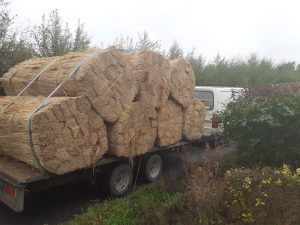
HTB money is claimed inside one calendar year — a trailer delivered in November for a job that cannot start until February may sit outside the year the grant can pay.
What belongs in the thatcher’s method statement
Local authorities will not fund a paragraph of goodwill.
A useful statement, of the kind thatchingireland.com already works to, says:
What is up there now, and in what condition
What will be stripped, what will be kept, and why
The new coat:
material,
finished thickness (350 mm is the figure both HA2T and Thatching Ireland use),
pitch,
fixing method
Ridge style,
wiring,
eaves and barge dressing
Chimney flashing and any carpentry that must precede the reed
Bird and vermin protection
A programme that fits the grant year, with weather contingency
A materials list the owner can order — bundle counts, spars, bars, screwfixings — not a lump labelled “thatch”
That last list turns a grant application into a shopping list, and a labour-only quote into a job that can start the week the trailer leaves the yard.
A sensible order of operations
Photograph the roof.
Get a thatcher to walk it and write the method statement.
Choose the scheme:
HA2T if you live in the house and want a year-round housing grant;
HTB if the building is historic and you can work inside the council calendar;
BHIS / HSF if the job is larger or the building is protected;
the farm scheme if it is an agricultural building on a participating holding;
Donegal’s repair grant if you are in that county and the job is small.
Apply before anyone climbs.
Wait for approval.
Buy the materials.
Thatch.
Keep every invoice.
Claim on time.
Book the first annual inspection before the grant file is closed.
Where to go
Thatching Grant (HA2T): gov.ie Thatching Grant — thatch@housing.gov.ie
Historic Thatch Grant / HTB: gov.ie Historic Thatch Grant, then your county conservation page
Farm buildings: heritagecouncil.ie
Donegal small repairs: donegalcoco.ie — thatch@donegalcoco.ie
Northern Ireland: communities-ni.gov.uk Historic Environment funding
Practice and inspections: thatchingireland.com
Tools and materials: thatchingtools.ie
Grants do not thatch roofs. Thatchers do.
Grants, used on time and with a clean file, make it possible for more of those roofs to stay thatched.
***Please do your own research. The above is a guide only.
Updated 28 Sept 2026

Thatching Tools Online in Ireland. Browse our range of roof thatching tools and materials.
Thatching Tools Online in Ireland. Browse our range of roof thatching tools and materials.
Click edit button to change this text. Lorem ipsum dolor sit amet, consectetur adipiscing elit